



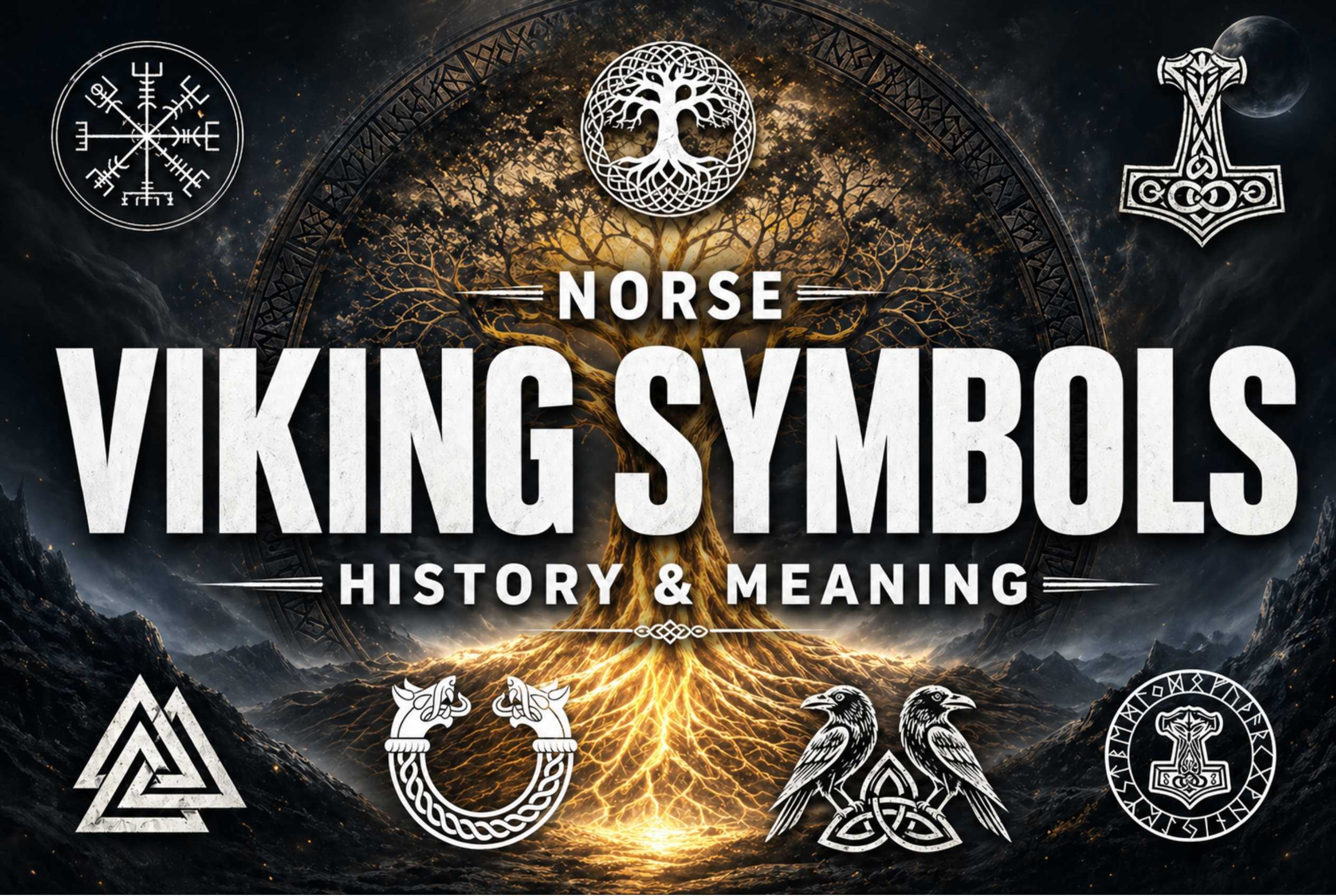
Norse-Viking Symbols and Their Meanings
The Complete Guide to 20 Sacred Norse Symbols
The most authentic guide to Norse and Viking symbols. Discover the true meaning behind each sacred symbol, their place in Norse mythology, and the most powerful jewelry pieces to carry their power on you today.
You did not click on this page by accident. Somewhere inside, you are looking for the symbol that already belongs to you. The Vikings believed symbols choose their wearer, not the other way around. Read carefully. One of the 20 below is going to feel like it was written for you. When you find it, you will know.
Start With the Symbols That Defined the Vikings
Before you dive into all 20, watch Hrafna tell the stories of the most powerful and well-known Norse symbols, the ones every wearer should know first. He brings them to life the way the Vikings would have wanted, as living stories, not dry history. Watch first, then explore the full guide below.
⚒ Hrafna
Norse mythology storyteller & heritage educator
🔥 Why these symbols still matter in 2026
- You feel disconnected from anything older than your phone, looking for a thread to something deeper.
- Modern jewelry is shallow, designed to look pretty, not to carry meaning that sustains you when life gets hard.
- You sense your Norse heritage or affinity calling, and want to honor it without playing dress-up.
- You're going through a life transition, recovery, grief, a new chapter, and you need an anchor that says "you are not the first to walk this path."
- You want a piece that tells your story in one glance, without saying a word.
⚡ This is what Norse symbols do that other symbols cannot
For over a thousand years, these 20 symbols have carried specific energy, specific meaning, specific power. The Vikings did not wear them for decoration. They carved them onto their skin, etched them onto their weapons, and buried their dead with them, because they believed each symbol activated something real.
Today, when you wear one, you tap into the same psychological technology the Vikings used. Each glance is a recommitment. Each touch is a return. The symbol becomes part of how you see yourself, and how the world sees you.
⚒ ⚡ ⚒ ⚡ ⚒ ⚡ ⚒ ⚡ ⚒ ⚡ ⚒ ⚡ ⚒ ⚡ ⚒
The WayfinderVegvisir: The Icelandic Compass

The Vegvisir, also known as the Nordic compass or the Icelandic stave of guidance, is a symbol found in Icelandic folklore and mythology. It is believed to be a magical compass that helps guide people through rough weather and rough terrain, helping them find their way even when they are lost or disoriented. The symbol consists of a circle with eight branches or spokes emanating from it, each ending in a distinctive hook or arrowhead shape.
The "Viking Age" has marked the Vegvisir's historical significance. Nowadays, it has become a popular symbol of protection and guidance. People often get tattoos or use it as a decorative element in jewelry. However, scholars and enthusiasts are still debating its origins, precise meaning, and significance.
🧭 Why people wear it today
You wear the Vegvisir when you are navigating a fog, in your career, in your relationships, in your sense of self. It is for the moments when the path is unclear but you must keep walking. Each time you see it on your hand or chest, it reminds you: you will find your way.


Knot of the SlainThe Valknut: Odin's Sacred Knot

The Valknut is a Norse symbol, specifically associated with all-father Odin. It is often depicted as a tri-knot because it is made up of three interlocking triangles.
Odin was said to wear the Valknut around his neck or on his belt, and the symbol has been found on many Viking artifacts such as brooches and sword hilts. This is thought to be because Odin would take the dead warriors' souls to Valhalla with him when they died in battle.
The name "Valknut" comes from the Old Norse word "valr", meaning fall or falling, and "knot", which comes from the Old English word "cnytt" or "cnytte", which means a noose or snare. Together, these words describe how the symbol has been interpreted as depicting death; specifically, that souls are captured by this knot when they die and go to Valhalla.
The Valknut symbol represents the power of the human spirit and the never-ending cycle of life and death. It serves as a reminder to embrace our mortality and to live each day with purpose and intention.
🔱 Why people wear it today
You wear the Valknut when you have chosen to live with intent, when you understand that death gives life its weight, and you refuse to waste a single day. It is the mark of those Odin chooses, those who fight, fall, and rise again.


The Helm of AweAegishjalmur: The Symbol of Protection

The Aegishjalmur, commonly referred to as the Helm of Awe, is an emblematic representation of protection and strength among the Viking symbols. This particular Viking symbol is an eight-pointed star that features intersecting lines at its center. It held great significance for the Vikings as it was believed to have helped them secure triumph in battles.
This ancient symbol has been found inscribed on helmets since the 6th century. In fact, it's believed that the word "helm" comes from "halm," which means "wave," and the Aegishjalmur is thought to represent wave patterns in its design.
According to Norse tradition, wearing the Aegishjalmur is believed to provide protection from falsehood, slander, sorcery, and other potential harms to one's life. Not only that, but the Aegishjalmur is also thought to enhance mental abilities and grant control over others.
🛡 Why people wear it today
You wear the Helm of Awe when you need to be unshakeable. When the world threatens to push you off-center, when fear creeps in before a confrontation, when you need to remember that you are not easily moved. It is armor you carry on your skin.


The Magical AlphabetViking Runes: Letters of Power

The Viking Runes are a system of writing that was used by the Norse people during the Viking Age, from the 8th to 11th centuries. This period of time is known as the Viking Age because it was when Vikings raided, traded, and explored much of Europe and Northern Africa. The writing system, called Futhark, evolved over time and eventually fell out of use.
As with many other cultures at the time, the Vikings believed that writing held power. Unlike the Romans, however, they thought that power came not from the written word itself, but from the magic inherent in their own alphabet. This belief is reflected in some of the names of runes; for example, one of them was called "the letter of victory" while another was named "the letter of joy."
The Vikings used Runes to record events and communicate with each other. They were also used in magic spells, often carved on stones or cast into objects like swords. Each rune carried its own meaning: Fehu for wealth, Algiz for protection, Tiwaz for courage, Othala for heritage.
ᚱ Why people wear them today
You wear the runes when you want a symbol that only you fully understand. Each rune is a coded vow, a quiet declaration of what you stand for. When others see them, they see ancient marks. You see your own intention.


Mythological BeastsDragons: Power, Treasure, & Transformation

Dragons were depicted as large, serpentine creatures with wings and sharp teeth. They were considered to be powerful and fearsome beasts that were associated with treasure and riches.
One of the most famous dragons in Norse mythology was Fafnir, who was a giant serpent that guarded a hoard of gold. Fafnir was originally a human prince, but after he killed his father to claim the gold, he was transformed into a dragon as punishment for his greed.
Other dragons in Norse mythology included Jörmungandr, the serpent that encircled the world, and Nidhogg, the dragon that gnawed at the roots of the world tree, Yggdrasil. Dragons were also associated with fire, chaos, transformation, and the guardianship of treasures both physical and spiritual.
🐉 Why people wear it today
You wear the dragon when you have something worth guarding, your dreams, your family, your peace. Dragons do not chase. They wait. And nothing takes from them what they have decided to keep.


The Bound WolfFenrir: The Untamed Spirit

Fenrir, the infamous Norse wolf, was so terrifying that even the gods caged him to prevent potential destruction. The tale of Fenrir's captivity serves as a warning about the perils of creating entities too potent to handle and denying them a chance at organic existence.
Fenrir was born as the offspring of two giants, as part of a prophecy that foretold his destiny to kill Odin, the leader of the Norse gods. Odin was so afraid of this prophecy that he tricked Fenrir into being bound by a magical chain on top of a mountain peak. Fenrir remained bound until Ragnarök (the end of the world), when he would break free.
This Norse legend shows us how Vikings saw themselves as part of nature, an extension of it, and believed that all creatures should be allowed to live their lives freely.
🐺 Why people wear it today
You wear Fenrir when you refuse to be tamed. When you have been bound, by circumstance, by expectation, by your own past, and you sense that your time to break free is coming. Fenrir is the symbol of those who will not be made small.


The World SerpentJormungandr: The Eternal Cycle

Jörmungandr is one of the more interesting creatures in Norse mythology. It is a gigantic sea serpent, said to be so large that it completely encircles the world and holds its tail in its mouth, keeping it pinned down into the ocean depths. It is one of three children of the god Loki and the giantess Angrboda.
Jörmungandr is said to be destined to do battle with Thor at Ragnarök. According to some accounts, Jörmungandr will grow so large that it will reach all the way around the world and bite its own tail, forming a ring around the world called Miðgarðsormur or Midgard Serpent.
Its representation embodies the cyclical nature of existence and is revered as one of the mightiest beings in Norse culture.
🐍 Why people wear it today
You wear Jormungandr when you understand that life moves in cycles, not lines. What was, will be again. What ends, will rise again. The serpent biting its tail is the reminder that your endings are also your beginnings.


The Tree of LifeYggdrasil: The Cosmic Connection

According to legend, Yggdrasil is a gigantic tree that serves as the center of the Nine Worlds (the nine realms inhabited by the Norse gods and other beings). In addition to being the connection point between these worlds, it also provides life to them all.
The word Yggdrasil means "Odin's horse" or, more literally, "Odin's steed". This may refer to the fact that Odin sacrificed himself by hanging from a tree and was then reborn, gaining the wisdom of the runes.
Yggdrasil's roots extend far into the ground. The three main branches of Yggdrasil are one leading to Asgard, home of the Aesir gods; another to Midgard, where humans live; and finally, one leading to Jotunheim, land of giants. The tree connects all worlds, all beings, all stories.
🌳 Why people wear it today
You wear Yggdrasil when you want to remember you are part of something vast, your family line, your ancestors, your future descendants, the whole web of life. It is the symbol of those who refuse to be isolated, who know they are a branch on a much older tree.


Thor's HammerMjolnir: The Symbol of Strength

One of the most famous Viking symbols is the Mjölnir, also known as Thor's hammer. According to Norse mythology, the gods tasked Brokkr and Sindri, the dwarves, with crafting the hammer.
Thor is able to use Mjölnir to travel between the Asgardian realm and Earth with ease, which made it a valuable asset during times when he had to defend his people from giants or other mythical creatures. The hammer also has the ability to return magically to its owner if it gets too far away from him.
The Mjölnir has been used as a sacred symbol for thousands of years. The earliest known representation of it is found on the Snoldelev Stone, carved by the Vikings between 800 and 900 CE. Archaeologists have unearthed over 1,000 Mjolnir pendants across Scandinavia, Iceland, England, and as far east as Russia.
⚡ Why people wear it today
You wear Mjolnir when you have decided that you will defend what matters to you. Family, principles, the people who depend on you. Thor's hammer is not just power, it is protection turned outward. The strength of those who use their force only to shield.


Odin's SpearGungnir: The Spear That Never Misses

The Gungnir is a spear of mythic proportions believed to be used by the Norse god Odin. As per the legend, the dwarves crafted the Gungnir with unparalleled craftsmanship, ensuring that it never missed its mark and always hit its target with precision.
The spear is also known as Gungner (Old Norse "swaying one") or the "Swaying One." Scholars suggest its name refers to Odin's use of it to symbolically sway or sway back the slain warriors on the battlefield during his role as leader of Valhalla's Einherjar.
Odin's spear, Gungnir, is renowned for its unparalleled precision and accuracy. It has gained a reputation for always striking its intended target.
🗡 Why people wear it today
You wear Gungnir when you have decided what you are aiming for, and you refuse to miss. It is the symbol of focused intent. The thing that hits its mark, every time, because the one who throws it does not waver.


The Warrior's ToolViking Axe: Strength & Bravery

The strength and skill of the Vikings are embodied in the Viking axe. This everyday tool was a vital part of their culture, used to construct their dwellings, navigate the seas, and even prepare their meals. But the Viking axe also served as a deadly weapon in battle, showcasing the Vikings' fierce and relentless nature.
In the Viking age, the axe was an extension of its user's body. The Vikings would carry axes with them everywhere they went and used them for tasks that ranged from everyday chores to worship to war. Axes were so important to the Vikings that they were often buried with their owners upon death.
The axe was a weapon of choice for the raiders and traders who spread far into Russia and beyond. They believed that their weapons were possessed by the spirits of past warriors.
🪓 Why people wear it today
You wear the Viking axe when you understand that the same tool that builds, can also defend. It is the symbol of the man who is both maker and warrior. The one whose hands can build a home and protect it.


Norse SuperhumansThe Berserker Bears: Trance Warriors

The Berserkers were a group of Norse warriors known for their ferocity in battle. They are believed to have been possessed by the spirit of the bear, which gave them superhuman strength and an insatiable hunger for battle.
"Berserker" is from the Old Norse word "berserkr," which comes from the words "ber" and "serkr." The word "ber" means bear in the Old Norse language and "serkr" refers to shirt or coat.
The Berserkers' talent for combat is described in many tales of Viking explorers who encountered lands that were foreign to them. When they could not find any way to settle peacefully, Berserkers would be sent out to scout the land and observe its inhabitants.
🐻 Why people wear it today
You wear the Berserker symbol when you know there is a wild force inside you that you have learned to channel, not suppress. It is the mark of those who can transform fear into fury, and fury into focused action.


The Viking LongshipDrakkar: The Ship of Discovery

The Viking Longship, also called the Drakkar, is an emblematic representation of the Nordic legacy. These viking ships were built with both practicality and symbolism in mind, providing the Vikings with rapid transportation to raid, loot, and explore new lands with minimal resources.
A Longship was a sleek and fast ship that allowed for quick attacks and fast getaways. The ships were light, but sturdy enough to hold several men (typically 30-40), an ox or two to help with rowing, and all the supplies needed for such a journey.
The Vikings used their Longships to raid, explore new territories, transport cargo and settlers between Iceland and Scandinavia, and even settle Greenland. The Drakkar represents the Viking spirit of discovery and the courage to sail into the unknown.
⛵ Why people wear it today
You wear the Drakkar when you understand that some shores are only reached by those willing to sail without a map. It is the symbol of those who refuse to die where they were born, who go looking for what calls them, even when it makes no sense to anyone else.


Geri & FrekiWolves: Loyalty & Power

Wolves are powerful predators in the animal kingdom, and humans have long known this. The wolves were viewed as powerful creatures, who often accompanied the god Odin as his companions.
It was said that Odin had two wolves named Geri and Freki. These two wolves were said to be always at Odin's side, and they were always ready to tear apart anyone who threatened the god or his family. Though Odin's wolf companions were known for their loyalty and ferocity in battle, they were also known for their kindness and affection towards Odin.
The physical wolf plays an important role in Viking funeral rites, where it is considered the soul's faithful companion on its journey to Valhalla.
🐾 Why people wear it today
You wear the wolf when you live by the pack's code: loyalty above all, family first, and never abandon what you love. The wolf is the symbol of those who are gentle with their own and unstoppable when their pack is threatened.


Huginn & MuninnRavens: Thought & Memory

Ravens were seen as symbols of wisdom, war, and death. They were associated with the god Odin, who had two ravens named Huginn and Muninn (meaning "thought" and "memory") that flew around the world and brought information back to him.
In mythology, Huginn And Muninn were always together; they are never mentioned separately from each other. They traveled freely around Midgard (the known world) each day and reported back to Odin at night.
The Vikings valued ravens for their loyalty and were known to keep them as pets. The raven was seen as an omniscient spirit animal that provided guidance for those devoted to it.
🪶 Why people wear it today
You wear the raven when you value thought before action, memory before judgment. It is the symbol of the one who sees what others miss. The watcher. The one who knows that wisdom comes from flying over the territory before walking it.


Odin's Eight-Legged HorseSleipnir: Speed & Mastery

Sleipnir is a mythical Norse creature that appears in Norse mythology as Odin's eight-legged horse. Sleipnir is described as being the fastest horse in the world, with the ability to travel through the nine realms of Norse mythology and even between the realms of the living and the dead.
He is also depicted as being able to bear the weight of the entire Norse pantheon, making him a powerful and formidable creature. Sleipnir is often associated with Odin, the chief of the gods, who is said to have ridden Sleipnir into battle.
Sleipnir is seen as a symbol of speed, power, and strength, and is revered by many as a deity in his own right.
🐎 Why people wear it today
You wear Sleipnir when you have decided to move faster than your circumstances. To outrun what would slow others down. To reach what others cannot reach. It is the mark of those who refuse to be left behind.


Scandinavian IconTroll Cross: Protection from the Unseen

The Troll Cross is a very popular symbol in Scandinavian culture, and has been for centuries. The cross is a depiction of the hammer used by Thor to kill giants, a story that is featured prominently in Norse mythology. In modern times, the Troll Cross is often used as a symbol of protection and good luck, and is often worn as a pendant or placed on amulets and talismans.
The Norse people believed that trolls were the physical manifestation of chaos, often appearing as hideous beasts and devouring humans and animals. It was believed that wearing a silver cross would protect its wearer from these creatures.
Today's troll is an internet-age version of its ancient ancestor. Instead of appearing as monstrous creatures, trolls now lurk online where anyone can become a victim of their malicious actions.
✠ Why people wear it today
You wear the Troll Cross when you have seen too much chaos and want a quiet ward against it. It is the symbol of the one who knows the world has dark corners, and refuses to let them in. A small piece of iron between you and what would harm you.

The Triple Horn of OdinTriple Horn: Wisdom & Inspiration

The Nordic triple horn is a traditional symbol that represents the Viking culture and mythology. It is a three-pointed symbol that is often depicted on Scandinavian artifacts such as jewelry, artwork, and textiles.
Within the symbol lies an animal head or skull with two horns extending out of the skull. This horned animal most likely represents how the Vikings viewed the symbolic meaning of animals, they were used to express human traits.
The three horns represent the three drinks of mead Odin drank to gain the power of poetry and wisdom. It is said that Odin used Mjölnir as a weapon to fight giants while traveling through the nine realms.
🥃 Why people wear it today
You wear the Triple Horn when you understand that true wisdom is earned through sacrifice. Odin lost an eye and hung from Yggdrasil for nine days for his knowledge. What have you been willing to give up to know what you know?


The Trinity KnotTriquetra: Unity of Three

The triquetra symbol is common in Celtic art, appearing on everything from stone carvings to stained glass windows. The triquetra is an enduring symbol of unity and balance. It represents the three realms of this universe: earth, sea and sky, as well as the three phases of life: birth, death and rebirth.
The triquetra's name is derived from the Latin word "tri-catus" meaning "three-cornered." In ancient Ireland, it was believed that the triquetra would protect against evil spirits and bring good luck to those who wore it.
This belief system spread to Scotland and Northern England, where the symbol was used to represent a wedding vow: "For better or for worse, for richer or for poorer, in sickness and in health."
☘ Why people wear it today
You wear the Triquetra when you live by the truth that three forces hold up your life, body, mind, spirit, or whatever trinity you honor. It is the symbol of the integrated person. The one who refuses to live in fragments.


Ancient Celtic SpiralTriskele: Past, Present, & Future

The triskele is a three-pronged symbol that was widely used in Celtic art, often as a decoration on shields and other war gear. The exact origins of the triskele are not known, but it likely has its roots in pre-Celtic art forms.
In Celtic art, the triskele was often used to represent a variety of things. It stood for the three realms of land, sea, and sky; for life's three stages (birth, life, and death); for the three cycles of time (youth, adulthood, and old age).
It was also considered to be a symbol of sovereignty and leadership, representing the king or queen's presence in all corners of their kingdom. The triskele is also believed to have spiritual and magical properties, bringing good luck, prosperity, and protection to those who wear it.
🌀 Why people wear it today
You wear the Triskele when you have made peace with your past, your present, and what is coming. It is the symbol of forward motion. The mark of the one who is always becoming, never stuck.


🔱 The Symbol Pairing Guide
Vikings rarely wore one symbol alone. They layered them, each one activating the next. Here are the most powerful combinations, the ones the warriors of old wore together.
 +
+
 +
+

The Warrior's Path
Mjolnir + Helm of Awe + Valknut. Strength to fight, protection to endure, courage to fall and rise again. Every Norse warrior wore at least two of these. Together, they form the complete warrior's signature, a man ready to defend, ready to attack, ready to face the end without flinching.
Best for: Men in transition, recovery, fighting personal battles, or marking a major life chapter.
 +
+
 +
+

The Seeker's Journey
Vegvisir + Yggdrasil + Runes. Direction to find your way, connection to know you are not alone, and the encoded wisdom to make the right choice when it matters. The combination for those who are building a life with intention, not just letting it happen to them.
Best for: Career changers, spiritual seekers, those at major crossroads.
 +
+
 +
+

The Wild Spirit
Fenrir + Wolves + Ravens. Untamed force, pack loyalty, and the wisdom to know when to strike and when to wait. The combination for those who refuse to be tamed but are not careless. Wild, but never reckless.
Best for: Independent spirits, leaders, those who walk alone but protect their tribe fiercely.
 +
+
 +
+
The Visionary's Trinity
Gungnir + Sleipnir + Ravens. Precision in your aim, speed beyond circumstance, and the foresight to see what is coming. For those who do not just want to react to life, but to see the future and ride toward it before it arrives.
Best for: Entrepreneurs, planners, strategists, anyone building something the world has not seen yet.
 +
+
+
+

The Cycles of Eternity
Jormungandr + Yggdrasil + Triskele. The eternal cycle, the cosmic tree, the spiraling forward of time. For those who have made peace with the truth that nothing ends, everything transforms. Worn together by those healing from grief, loss, or massive change.
Best for: Those processing loss, transformation, or honoring those who came before.
Frequently Asked Questions
What is the most powerful Viking symbol?
The most powerful Viking symbol is widely considered to be Mjolnir, Thor's hammer. It possesses magical properties that grant the wearer strength to ward off malevolent beings and protect their clan from harm. The word mjölnir translates to "that which smashes" or "that which crushes," solidifying its reputation as a symbol of strength and destruction. Archaeologists have unearthed over 1,000 Mjolnir pendants across Viking territories.
What is the Viking symbol for warrior?
The Valknut stands as the most powerful symbol of the brave and valiant warrior. It represents Odin, the god of war and death, and the interconnectedness of life and death. In battle, warriors would carve the Valknut into their flesh, hoping the Valkyrie would see it and guide their souls to the halls of Valhalla should they fall in combat.
What is considered as a symbol of good luck in Norse culture?
Thor's Hammer (Mjolnir) is the most widely recognized symbol of good luck in Norse culture, often seen adorning structures, including certain churches, across Scandinavia. Its significance lies in Thor's ability to safeguard humanity from malevolent forces. The Troll Cross is another popular Norse symbol of good luck and protection, especially against evil spirits and chaos.
Can anyone wear Norse symbols, or do you need to be Scandinavian?
Anyone can wear Norse symbols regardless of heritage or background. These symbols carry universal meanings of strength, protection, guidance, and connection that transcend ethnicity or religion. They are worn today by people who connect with their meaning, whether through Norse ancestry, mythology enthusiasm, spiritual seeking, or appreciation of bold meaningful design.
What is the difference between Norse symbols and Celtic symbols?
Norse symbols (Mjolnir, Valknut, Vegvisir, Aegishjalmur) come from Scandinavian and Viking culture and are connected to Norse mythology, gods like Odin and Thor, and Icelandic magical traditions. Celtic symbols (Triquetra, Triskele, Trinity Knot) come from Irish, Scottish, and Welsh Celtic cultures with different mythological roots. Both share themes of protection, unity, and life's cycles, and are often worn together in Norse-Celtic jewelry traditions.
How do I choose the right Norse symbol for me?
Choose the symbol that matches what you need most in your current life chapter. For protection, choose Aegishjalmur or Mjolnir. For guidance through uncertainty, choose Vegvisir. For strength in transition, choose Fenrir or Berserker. For connection to lineage, choose Yggdrasil. The Vikings believed the symbol chooses its wearer, the one that catches your attention most strongly is usually the one you need.
Can I wear multiple Norse symbols together?
Absolutely. Vikings rarely wore just one symbol. They layered them, with each symbol activating different aspects of life. Common combinations include Mjolnir + Helm of Awe (strength + protection), Vegvisir + Yggdrasil (guidance + connection), and Fenrir + Wolves (untamed force + pack loyalty). See our Symbol Pairing Guide above for the most powerful combinations.
Will Norse symbol jewelry tarnish or fade?
No. All Epic Loot Norse symbol jewelry is crafted from premium 316L stainless steel or 925 sterling silver, both of which are corrosion and tarnish resistant, hypoallergenic, and built for daily wear. They handle water, sweat, the gym, and weather without fading. Every piece comes with a lifetime warranty for your peace of mind.
Your Symbol Has Been Waiting for You
For over a thousand years, these 20 symbols have carried the power, protection, and meaning of the Norse warriors who wore them. One of them is yours. You felt it when you read about it. The Vikings believed the symbol chooses its wearer. Now is the time to claim it.
Shop the Full Norse Collection
Informative and pleasant to watch
I have a great grandmother who was from Norway her name was Margaret Noff. I no nothing about her and am trying to find information on her. However my question is: I was given a sweatshirt that says Norse lives matters with a white Anker looking thing and black lines inside the Anker. What does this mean? Can you please help me? Thank you very much!
Děkuji krásně napsáno i překlad výborný ,
I left home when I way 3 years old, and have only been back once. I’ve always been proud of my Icelandic roots and very interested in learning as much as possible about where I was born. Thank you for all the knowledge and information you put out there about Iceland.
Thanks again
Thorsteinn
Wonderful piece of knowledge. Short concise and explains a lot!
Leave a comment